
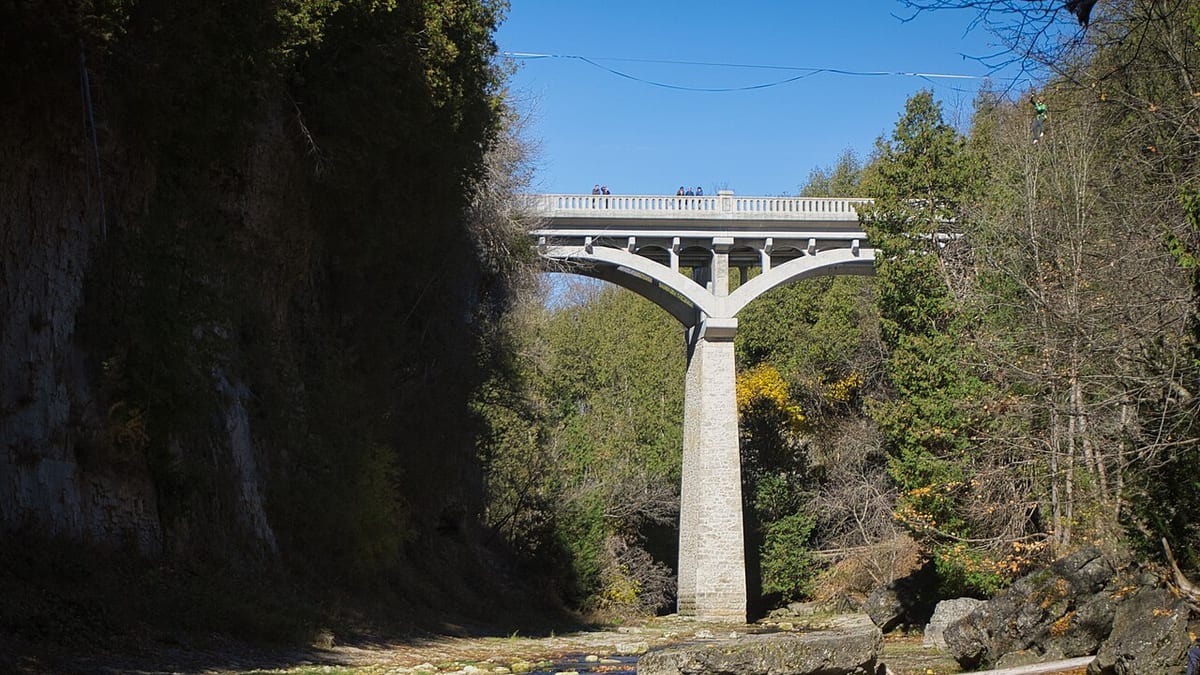
Driving is the simplest Toronto-to-Elora option for a flexible day out, especially when you want the village and a conservation area. Without a car, travel to Guelph and connect with GOST or a prebooked RIDE WELL journey. The crucial distinction is that Elora village, Elora Gorge Conservation Area and a tubing outing are not interchangeable destinations.
Build the trip around your actual destination
Start by deciding what you are going for. A village visit can be a relaxed combination of lunch, shops and a riverside walk. A conservation-area outing has different opening dates, admission arrangements and access points. A tubing day introduces equipment, weather and booking constraints on top of the journey.
Elora Gorge Conservation Area publishes a regular season of May 1 to October 15. As of this article's October 28 publication date, that season has ended. The village has not thereby "closed for winter"; it is the conservation-area operation that must not be assumed available. [1]
This distinction prevents an expensive mistake: arranging a long taxi ride to a closed recreation entrance when the intended visit was really to the village. Put the precise address into every transport booking rather than relying on "Elora Gorge" as a loose description of the whole destination.
For a first visit without a car, choose a village-focused day. Add the conservation area only after establishing its seasonal access and the extra journey between your arrival point and the entrance. Do not assume a regional bus deposits visitors at a trailhead.
Reach Guelph before choosing the last leg
Use GO Transit's date-specific journey planner from your Toronto departure point to Guelph Central. The result may involve a train, a bus or a combination, depending on the day and service arrangements. The planner also links service updates; a normal route description is not a guarantee that rail service operates unchanged on your particular weekend. [2]
Work backwards from the Elora connection rather than taking the first convenient train out of Toronto. Allow an unhurried transfer in Guelph, particularly when arriving on a replacement bus or with luggage. Buying the first leg does not reserve a place on a separate regional service.
A late start can turn a feasible day trip into an awkward overnight problem. Check the return connection at the same time as the outward one. The last leg back to Guelph is more restrictive than simply finding a later train toward Toronto.
GOST is the useful scheduled connection
Guelph Owen Sound Transportation, or GOST, serves Elora between Guelph and Owen Sound. The city's current service page lists Guelph Central at 79 Carden Street and the Elora stop at 25 Metcalfe Street, beside the municipal parking lot near the LCBO. The published Guelph–Elora fare is CA$5 each way, paid in exact cash. [3]
The same live page lists morning departures from Guelph at 10:38, reaching Elora at 11:05, and an afternoon southbound Elora departure at 16:35. Used together, those published times allow approximately five and a half hours in the village. Treat this as a timetable-based example, not a reserved itinerary; confirm the operator's current times before attaching nonrefundable bookings to it. [3]
The afternoon northbound arrival is not a useful replacement for the morning trip on a same-day visit. It reaches Elora after the listed afternoon southbound return has gone. Looking only at "two buses daily" hides this directional problem.
GOST operates seven days a week except Christmas Day. Its funding has been confirmed through December 31, 2026; the municipal announcement says 2027 funding remains a budget matter. A winter or spring 2027 itinerary therefore needs a fresh service check, not an assumption that the present arrangement continues indefinitely. [4]
RIDE WELL offers flexibility, but only within its rules
Wellington County's RIDE WELL is an on-demand shared service. It operates Monday to Friday, 06:00–19:00, excluding public holidays. Trips can connect Guelph with Wellington County, provided one end lies within the county. Registration is required and bookings can be made up to seven days ahead. [5]
That makes it a possible Guelph-to-Elora solution on a weekday, not a Saturday-night rescue service. Book both directions and allow for shared routing rather than assuming a private, immediate taxi-style journey. The service's published operating window includes the trip itself; it is not merely a deadline for requesting a pickup.
The fare formula is CA$0.60 per kilometre per person, with a CA$5 minimum and CA$40 maximum each way. Additional passengers on the same booking receive a 50 percent discount. For an illustrative quoted route of 25 kilometres, the first passenger would pay CA$15 and a second CA$7.50, before any applicable promotion; 25 kilometres is an example, not a measured Guelph–Elora fare. [6]
Compare the actual quote with a taxi when traveling as a group. The best option depends on pickup location, timing and whether a shared journey fits the day's plans, not just the cheapest advertised minimum.
When driving is worth the expense
A car is the straightforward choice for several destinations, bulky outdoor equipment or an overnight stay away from the village centre. It also lets you change plans when weather makes the intended outdoor activity unattractive. Use a live route estimate from your actual Toronto address rather than treating a single city-to-city driving time as universal.
Budget for parking and conservation admission as well as fuel or rental. A lower headline rental rate can be outweighed by insurance choices, an additional driver or a distant pickup location. For a group, compare the complete shared cost with train tickets and both onward transfers.
Do not build the return around the latest possible arrival in Toronto. A meal running late, busy roads or an unfamiliar rental-car return can consume the apparent saving. An overnight stay is often the more comfortable choice when the purpose is a long outdoor day rather than a short village visit.
Tubing changes the logistics
The conservation authority requires online tubing reservations rather than walk-up purchases and warns that water conditions can interrupt operations. Admission to the conservation area is separate. It also states that the tubing shuttle no longer operates: participants walk about 1.3 kilometres each way between the equipment area and river access. [7]
That walking requirement matters when comparing a casual sightseeing day with an activity day. It affects footwear, energy, the time needed before departure and who will enjoy the outing. A booked regional return should leave room for equipment return and changing, not simply the expected time on the water.
Stay behind the conservation area's marked barriers and on permitted trails. The gorge has steep cliffs, and the authority does not designate it as a swimming area. A river photograph is not an invitation to find an unofficial route down. [1]
For most car-free first visits, the strongest plan is the least complicated: an early Toronto departure, a confirmed Guelph connection, several hours in the village and a return chosen before lunch reservations are made. Reserve the more elaborate gorge outing for a day when seasonal access, transport and activity bookings all line up.